UNIST site map
- Admissions
-
Academics
- Colleges and Schools
-
Academic Affairs
- Academic Calendar
- Academic Curriculum
- Requirements for Graduation
- Browse Open Courses
- Undergraduate Administration
-
Graduate Academic Affairs
- Tuition Fee Payment
- Academic Leave of Absence/ Academic Return
- Voluntary Withdrawal/ Expulsion
- Change of Major
- Change of Degree Program/ Dropping of Degree Program
- Class Period/ Attendance Period/ Academic Year・Semester
- Course Registration
- Course Drop
- Attendance/ Grade/ Exam
- Credit Transfer/ Credit Carryover
- Academic Forms
- Education Support
-
Research/Industry
- Research Aims
- Research Findings
- Researcher Search
-
Research Organizations
- UNIST Multi-Interdisciplinary Institute
- IBS Research Groups
-
UNIST Labs
- Department of Mechanical Engineering
- School of Energy and Chemical Engineering
- Department of Civil
- Department of Materials Science and Engineering
- Department of Nuclear Engineering
- Department of Industrial Engineering
- Department of Design
- Department of Biomedical Engineering
- Department of Biological Sciences
- Department of Electrical Engineering
- Department of Computer Science and Engineering
- Department of Mathematical Sciences
- Department of Chemistry
- Department of Physics
- School of Business Administration
- Graduate School of Carbon Neutrality
- Graduate School of Artificial Intelligence
- Research Support
- University-Industry Relations
- Campus Life
- News Center
- About UNIST
-
etc
- UNIST Bulletin
- Work-Life Balance Support System
- UNIST Gender Equality Plan
- Faculty Invitation for Tenure Track
- Faculty Invitation for Non-Tenure Track
- Board Meeting Minutes
- University Council Meeting Minutes
- Administrative Service Charter
- Privacy Policy
- Copyright Policy
- Rejection of Unauthorized Email Collection
- Operation and Management Policy for Video Information Processing Devices
- Information Disclosure


Connection Points of Knowledge, Everything About UNIST
Try searching.
Recommended search terms


- portal
- U Academics Innovation Center
- Leadership Center
- Dormitory
- Academic Information Center
- International Students Support
- Browse Open Courses
- Course Registration
- Graduation Requirements for Graduation
- Academic Leave of Absence/ Academic Return
- Military Service
- Certificate Issuance
- Academic Calendar
- Scholarships
- Campus Map
- Campus Life Guidebook
- Health Care Center
- Human Rights Center
- portal
- Job Opening
- Announcement for Bid
- UNIST AI Services
- UNIST Daycare Center
- Sports Center
- UI Downloads
- Announcement
- Recruitment of Professors (Non-tenure)
- Faculty Invitation for Tenure Track
- UNIST Academic Information Center
- Office of Research Facilities and Training
- Office of Research Affairs
- Rule Management System
- Academic Calendar


This is a collection of menus necessary for UNIST students .
students
- portal
- U Academics Innovation Center
- Leadership Center
- Dormitory
- Academic Information Center
- International Students Support
- Browse Open Courses
- Course Registration
- Graduation Requirements for Graduation
- Academic Leave of Absence/ Academic Return
- Military Service
- Certificate Issuance
- Academic Calendar
- Scholarships
- Campus Map
- Campus Life Guidebook
- Health Care Center
- Human Rights Center


This is a collection of menus necessary for prospective UNIST Students .
prospective Students


This is a collection of menus necessary for UNIST Faculty & Staff .
Faculty & Staff
- portal
- Job Opening
- Announcement for Bid
- UNIST AI Services
- UNIST Daycare Center
- Sports Center
- UI Downloads
- Announcement
- Recruitment of Professors (Non-tenure)
- Faculty Invitation for Tenure Track
- UNIST Academic Information Center
- Office of Research Facilities and Training
- Office of Research Affairs
- Rule Management System
- Academic Calendar


NEWS CENTER
Discover not only Research Findings and event news, but also the diverse facets of UNIST presented by reporters and writers.
News Center

UNIST News
UNIST Researchers Recognized for Data Distillation Excellence at ICLR 2026
Professor Jae-Young Sim’s team has achieved a significant milestone with two papers accepted for presentation at the ICLR 2026.
- Research
- JooHyeon Heo
- 2026.06.11
- 2232

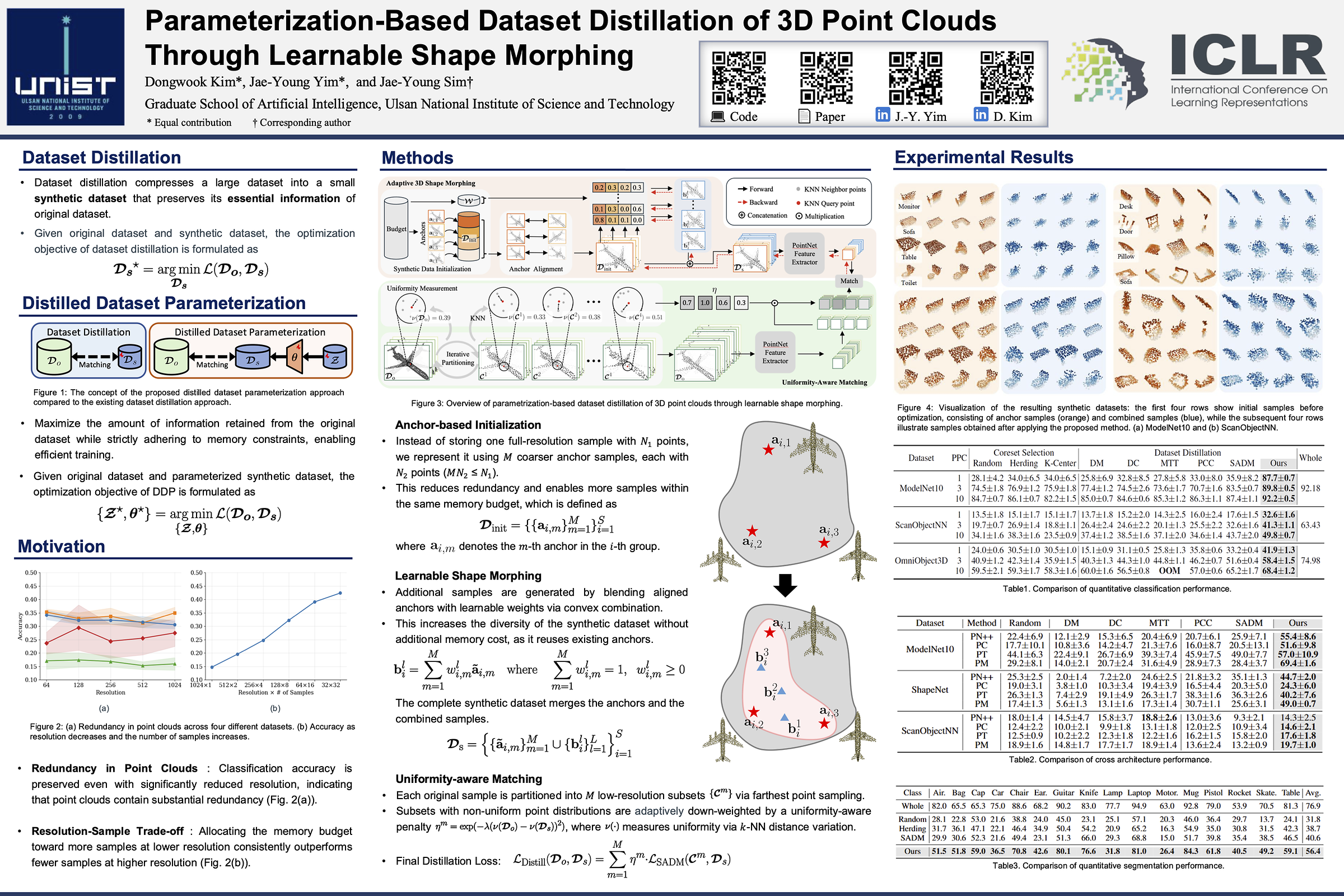
The research, conducted by Professor Jae-Young Sim and his team from the Graduate School of Artificial Intelligence at UNIST, has received notable recognition with two papers accepted for presentation at the International Conference on Learning Representations (ICLR) 2026—one of the most prestigious venues in machine learning research.
Their work addresses one of the fundamental challenges in deploying artificial intelligence (AI) at scale: managing vast datasets—often comprising millions of images or extensive 3D scans—that demand enormous computational power and energy. To overcome this, the team developed advanced methods for dataset distillation, a process that synthesizes compact, highly representative datasets capable of training models effectively while dramatically reducing training time, computational costs, and energy consumption.
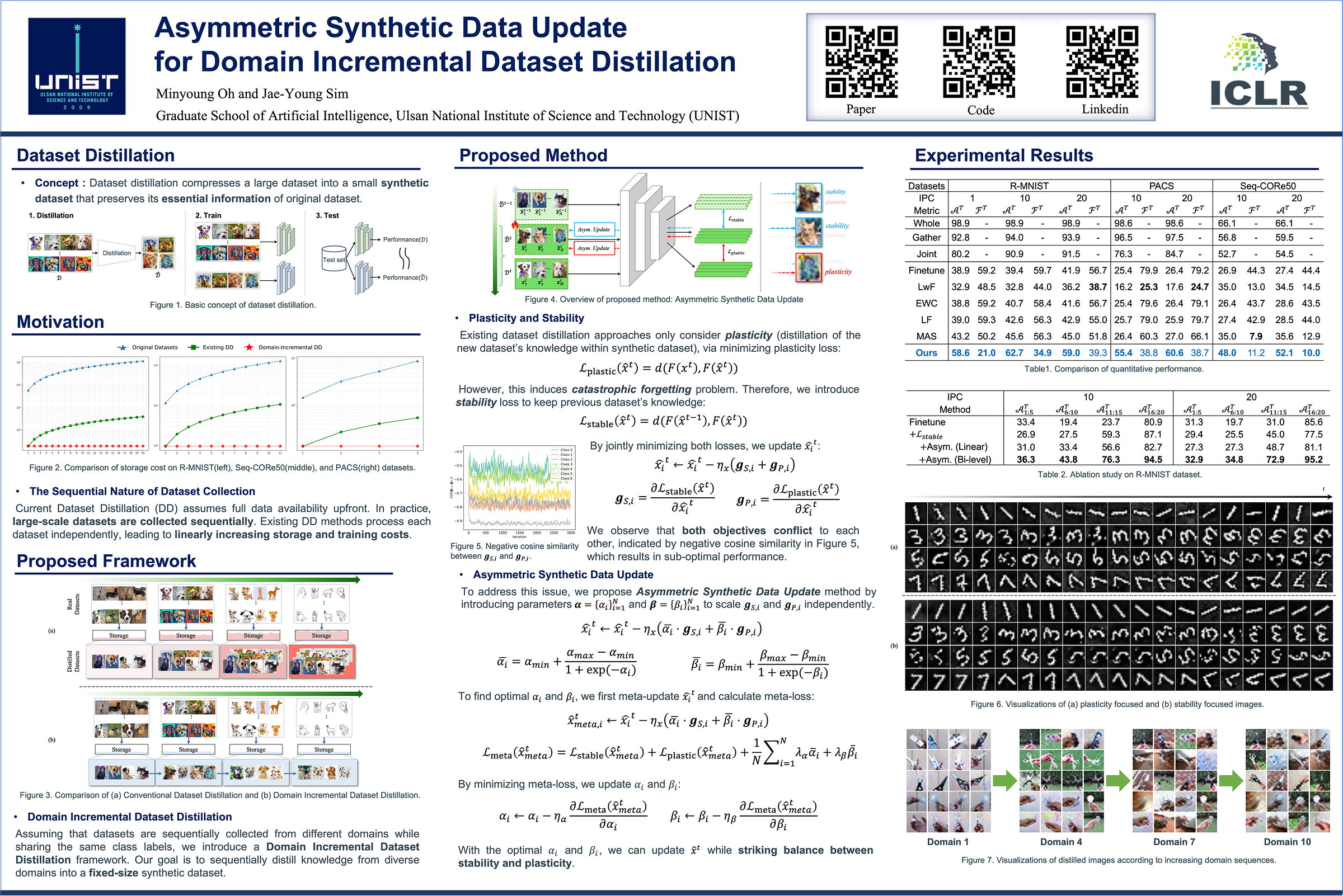
■ Advancing 3D Point Cloud Compression via Dataset Distillation
A key challenge tackled by the team involves the compression of 3D point cloud data—crucial for applications such as autonomous vehicles and robotic perception. Unlike traditional images, point clouds are irregular and unordered, making them difficult to compress efficiently with conventional methods. Existing approaches often rely on storing a single high-resolution synthetic sample, which limits diversity and robustness within constrained memory budgets.
To address this, Professor Sim and his team—comprising Dongwook Kim and Jae-Young Yim—developed a novel framework tailored specifically for 3D data. Instead of a single representative sample, the method employs multiple low-resolution anchor point clouds. These anchors are then smoothly transformed into a variety of synthetic shapes through a learnable shape-morphing mechanism, enabling the generation of diverse, high-quality 3D samples within a limited memory footprint. To preserve structural fidelity, the researchers introduced the Uniformity-Aware Matching Loss function, which maintains the geometric relationships inherent in the original data.
Extensive evaluations across multiple benchmark datasets—including ModelNet10, ModelNet40, and ShapeNet—demonstrated that this approach surpasses existing methods, achieving remarkable accuracy even under severe compression. Notably, in the most constrained scenario—using only a single synthetic sample per class—the recognition accuracy increased from 35.9% to 87.7%, illustrating the method's efficiency and robustness.
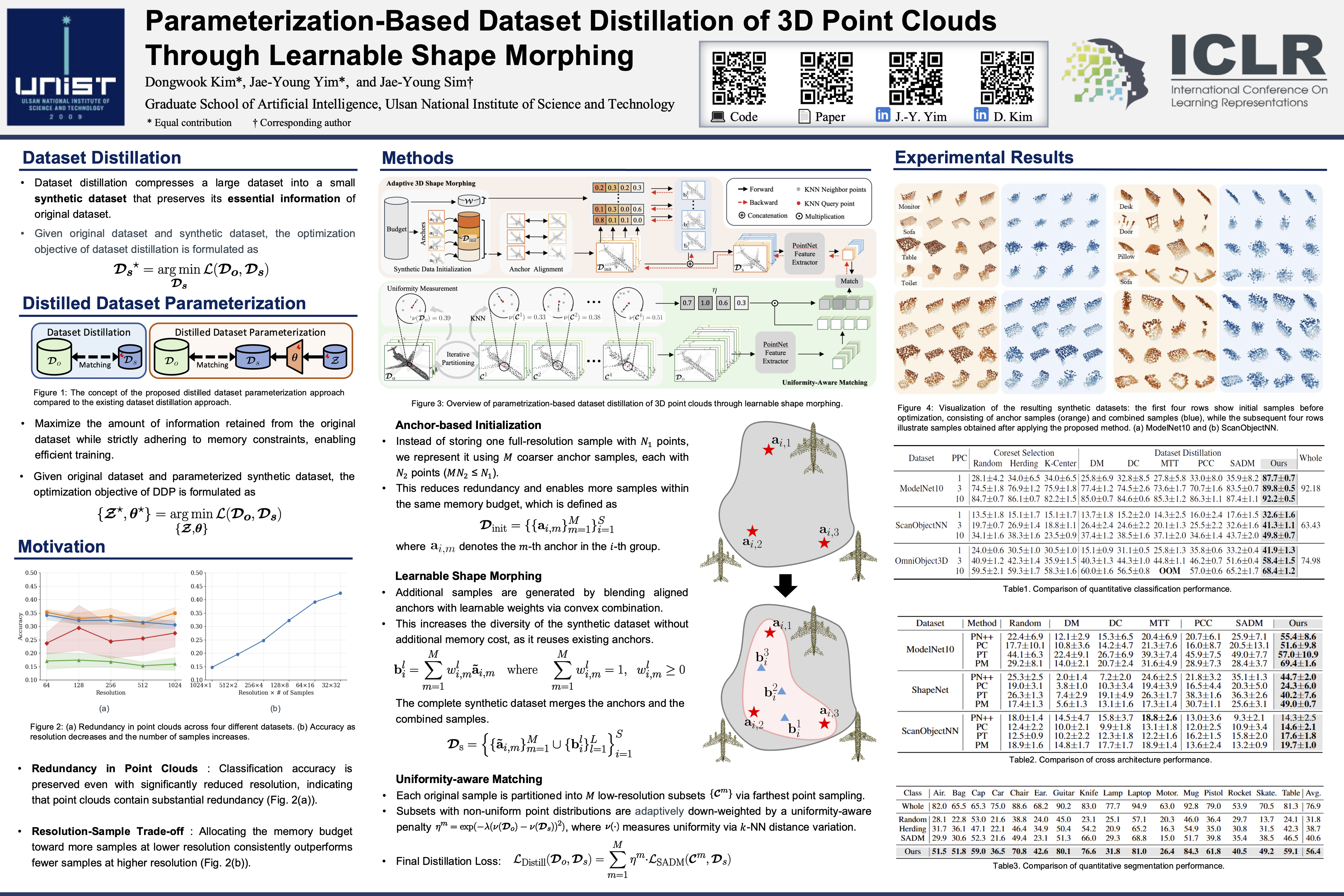
■ Enabling Continual Learning through Dynamic Dataset Updating
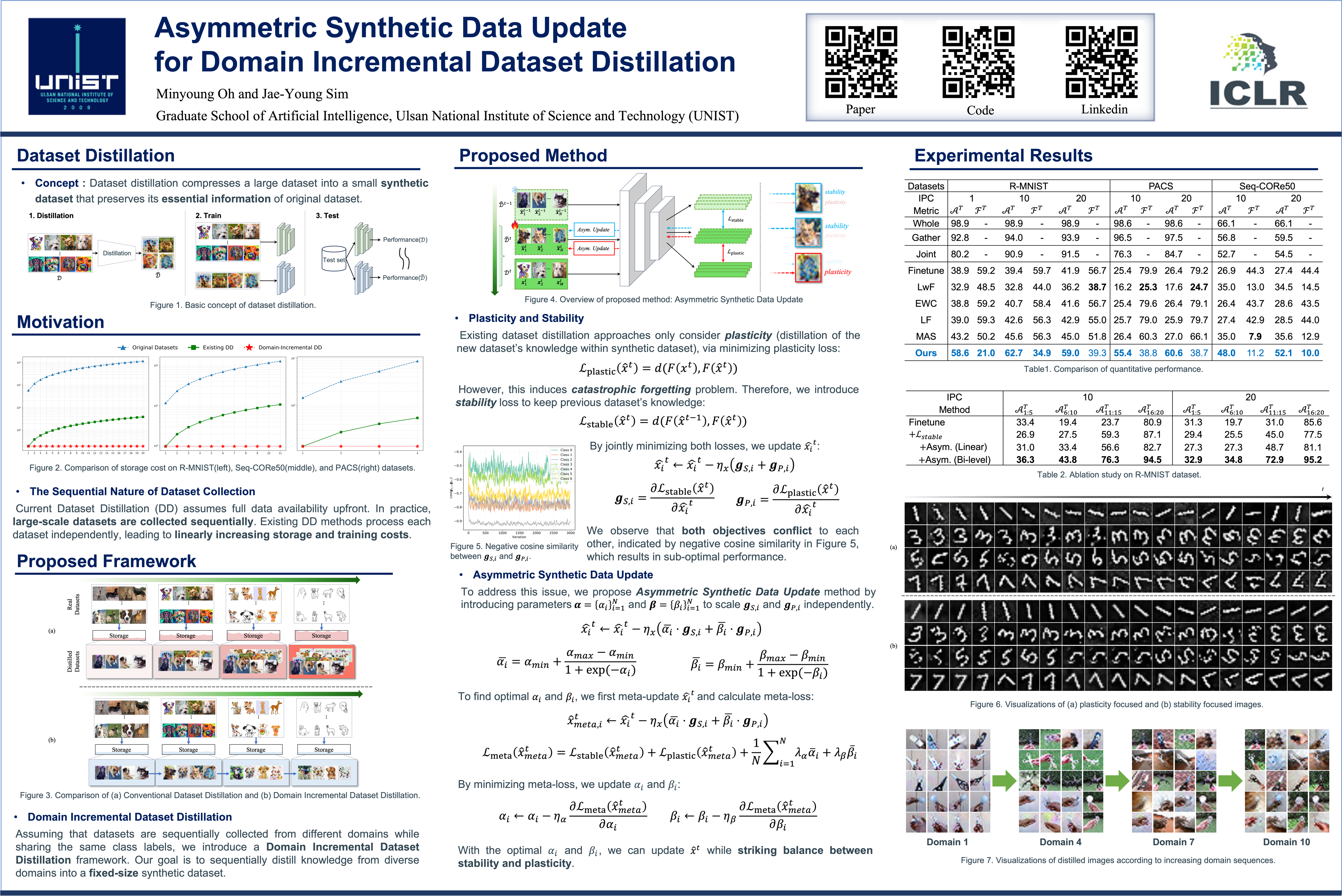
Beyond static data compression, the team addressed the challenge of continuous learning in dynamic environments—where new data continually arrives, and models must adapt without losing prior knowledge. Traditional dataset distillation approaches often require creating separate synthetic datasets for each new batch, leading to increased storage and computational costs. More critically, repeatedly updating a fixed synthetic dataset risks Catastrophic Forgetting , where previously learned information is overwritten.
To tackle this, the researchers developed an Asymmetric Synthetic Data Update strategy. This innovative approach dynamically adjusts the influence of each synthetic sample during updates, allowing the dataset to incorporate new information while retaining past knowledge. A bi-level meta-learning framework automatically determines optimal per-sample update rates, balancing stability and plasticity. This enables the synthetic dataset to evolve continuously, effectively mitigating forgetting and maintaining high performance over time.
Experimental results demonstrate that this method facilitates efficient lifelong learning within fixed storage capacities, making it highly suitable for real-world applications, such as autonomous vehicles, robotics, and edge devices.
Professor Sim remarked, “Our work exemplifies how intelligent data synthesis and adaptive updating strategies can make AI systems more resource-efficient, scalable, and capable of lifelong learning. We believe these advancements will accelerate the deployment of smarter, more sustainable AI in diverse real-world environments.” The study was led by Minyoung Oh, serving as the first author.
Related Links
Related Photo


-
AI Recognizes 3D Objects from Natural Language in Five Seconds
-
New Study Unveils Precise Calibration Method for Event Cameras in Autonomous Systems
-
New AI Algorithm to Enhance Accuracy of Thermal and Stress Predictions in Semiconductors
-
UNIST Unveils AI-Driven Framework for Real-Time Multi-Pollutant Air Quality Monitoring